Many organizations treat digital accessibility like an annual inspection: Run an audit, fix issues that appear, file the report, and move on. The trouble is that digital content never stands still. New files are uploaded every month, existing documents get revised, and old templates get reused. Research on web accessibility increasingly points to a better approach, which is to treat accessibility as an ongoing process that is measured and managed continuously, not a project with a finish line (Burkard et al., 2021; Campoverde-Molina et al., 2021).
Issues with one-time accessibility audits
An audit is a snapshot. It shows how accessible your content was on the day it was reviewed, but it can’t account for anything added or changed afterward. A clean audit result can therefore create a false sense of security, because the next round of uploads and edits may reintroduce the same problems without being noticed.
Researchers have built models that move away from the single-evaluation mindset. Campoverde-Molina et al. (2021) propose a process model for continuous accessibility testing with a cycle that repeats, so accessibility work is never “done.” The model calls for continuous testing with automatic evaluation tools, end-users, and experts to confirm that changes have had an effect (Campoverde-Molina et al., 2021). The lesson for institutions is that checking for compliance has to be an ongoing activity built into normal routines.
What effective monitoring looks like
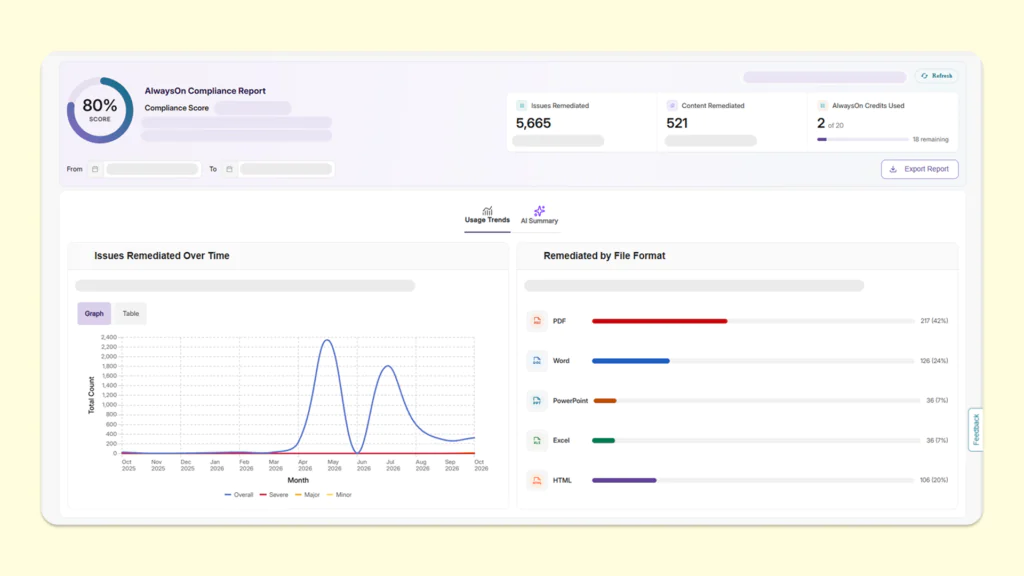
If continuous monitoring is the goal, what separates a useful accessibility monitoring system from a simple error list? Burkard et al. (2021) examined this question by evaluating commercial accessibility monitoring systems. They looked at how far these systems promote accessibility, which functionality they offer, and how they perform compared to other systems. The authors also found that these tools focus not only on finding accessibility errors, but on tracking a complete website’s progress over a longer period (Burkard et al., 2021).
Trend data shows which interventions are working and where issues keep recurring, and it gives leadership something concrete to act on. Burkard et al. (2021) paid attention to how motivating these tools are, emphasizing that reporting should be clear and usable enough that people actually engage with it.
How YuJa helps you reach compliance
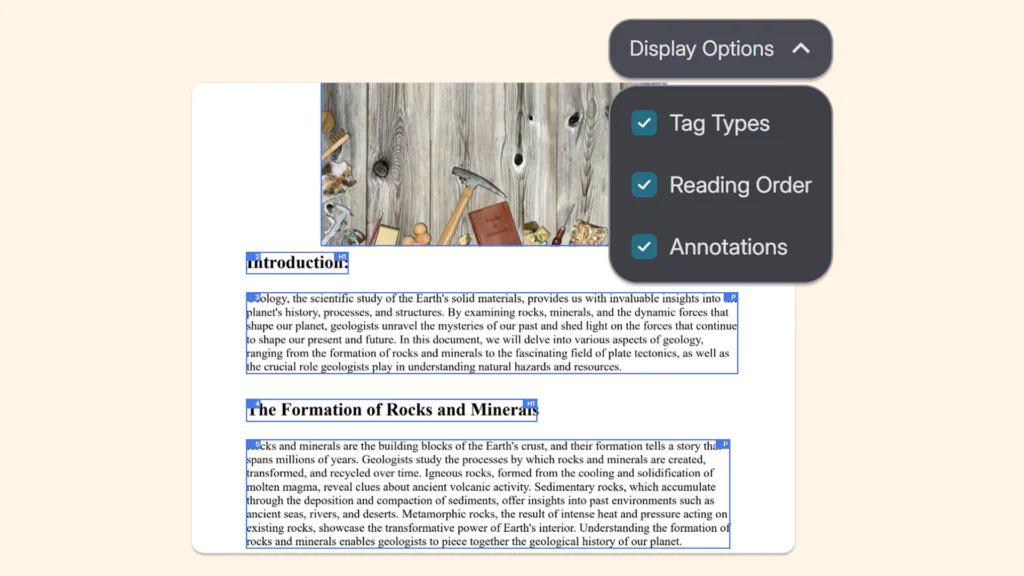
The YuJa LiveFix Website Accessibility Module, added in YuJa EqualGround’s v26.7.0 release, is an AI-powered tool that automatically remediates accessibility issues directly on your website without needing to make any changes to your CMS.
This automated workflow allows users to fully customize how they want to leverage automation to help them reach accessibility compliance. YuJa LiveFix Website helps administrators regularly update their websites and catch post-audit accessibility issues, rather than leaving them to wait for the next scheduled review. It fixes accessibility issues in real time as pages load, helping ensure websites are always accessible for visitors.
Conclusion
The research agrees: Accessibility holds up best when it’s built on repeated checking and measurable progress. Institutions that adopt continuous monitoring can catch problems as they appear and show their progress with data.
Citations:
Burkard, A., Zimmermann, G., & Schwarzer, B. (2021). Monitoring systems for checking websites on accessibility. Frontiers in Computer Science, 3. https://doi.org/10.3389/fcomp.2021.628770
Campoverde-Molina, M., Lujan-Mora, S., & Valverde, L. (2021). Process model for continuous testing of web accessibility. IEEE Access, 9, 139576–139593. https://doi.org/10.1109/access.2021.3116100