Product Updates

Get the latest platform updates, features, and announcements—all in one place.

  • May 2, 2025

    5 Ways to Bridge the Student Technology Expectation Gap

    The report outlines six aspects of the student experience in higher education, including satisfaction with technology-related services and supports; modality preferences; hybrid learning experiences; generative AI in the classroom; workforce preparation; and accessibility and mental health. Key technology service and support findings include: 
      • While most students (69%) said they were satisfied with tech-related services and support, 72% rated their institution’s use of technology for enhancing education as “average.”
      • Students who see their institution as cutting-edge in technology adoption are more satisfied (85%) with tech services and support than those who view their institution as average (68%) or behind the times (34%).
      • Students at institutions perceived as technology leaders feel more career-ready and confident in the value of their education.

      Bridging the Technology Gap

      To help bridge the gap between student expectations and delivery, institutions can:  1. Invest in Comprehensive Video Solutions: The report notes, “Video content (e.g., recorded lectures, instructional videos, multimedia resources) helps students grasp difficult concepts and provides flexibility in learning (i.e., students can learn asynchronously on their own time).” Institutions should adopt a Video Platform with tools that are easy to use by students and instructors. Encourage content creators to add interactive features like video quizzing, and show students how to use tools like in-video comments, video search, and more to improve learning and comprehension. 2. Prioritize Accessibility and Flexibility: “Technology helps personalize the learning experience and makes it more engaging (e.g., through the use of adaptive learning features, virtual tutoring, and interactive and individualized content and feedback),” the report states. Institutional leaders and instructors should help ensure content is accessible to all learners by using tools that offer automatic captioning, transcriptions, various alternative formats, and offline viewing options.  3. Streamline Technology: “Students want more seamless technology experiences,” the report says. Further, “ Course materials that are not well-adapted for online platforms result in confusing formats, submission errors, and grading issues (i.e., when rigid, automated grading is implemented).” Create a cohesive learning environment through tight LMS integration; reduce student frustration with single sign-on across systems, and work to maintain a consistent user experience across institutional platforms. In addition, conduct regular technology audits to identify redundant systems, outdated platforms, or disconnected tools that create friction in the student experience, and develop a strategic plan to consolidate or replace them with more integrated solutions. 4. Use Analytics to Make More Informed Decisions: Track how students interact with content to identify engagement patterns, analyze the relationship between engagement and academic achievement, and continuously improve the learning experience. 5. Invest in Technology Professional Development: The report indicates that students value instructors who effectively use technology in teaching. Help instructors use video technology effectively by offering training programs and support, and by creating technology champions who can mentor others and promote wider adoption. The report is clear: institutions that effectively use technology create better student experiences and outcomes. By adopting tools and solutions that are intuitive, accessible, and integrate with other technologies, institutions can bridge the technology gap and position themselves as leaders in educational innovation. Read the full report. 
  • April 4, 2025

    YuJa to Participate in the UAE’s 2025 Best Practices in Teaching and Learning Conference

    The conference marks the third annual collaborative event between three leading universities in the UAE: Khalifa University in Abu Dhabi, American University of Sharjah in Sharjah, and Amity University in Dubai. It brings together educators, technologists, and academic leaders from across the region to exchange ideas and showcase innovative approaches to education.
    “The field of education continues to evolve and is as dynamic as it is fundamental to how societies develop over time.”
    This year’s event focuses on student engagement, with each participating university bringing its own unique perspective to this central theme. Khalifa University will explore STEM education innovations and experiential learning approaches; American University of Sharjah will showcase emerging educational trends that blend cross-disciplinary research with creativity; and Amity University Dubai will examine how assessment strategies are evolving in response to generative AI technologies. “The field of education continues to evolve and is as dynamic as it is fundamental to how societies develop over time,” the event website notes. “From the impact of advanced technologies on teaching strategies to collaboration strategies between educational institutions and private or government entities, to innovations in teaching and learning approaches, there are a myriad of topics that the world of academia can be inspired at this teaching and learning conference in 2025.” YuJa will showcase how its comprehensive suite of tools can enhance student engagement across diverse learning environments and cultures. Conference participants will have opportunities to explore hands-on demonstrations of YuJa’s platforms and talk with the team about ed-tech solutions that enhance student engagement.  “Student engagement is at the heart of effective learning, and our solutions are designed to help educators create more dynamic and interactive experiences that resonate with today’s learners,” said Anas Shaqqour, Business Development Manager at YuJa, Inc. “We’re excited to participate in this conference, to chat with institutional leaders and educators, explore the region, and to be a part of the future of student engagement in the UAE and the Middle East.” If you’re at the event, be sure to find Anas to chat or learn more about YuJa’s student engagement solutions. If you can’t attend but still want a demo, contact us or check out our upcoming events.
  • February 7, 2025

    Trends Shaping Higher Education in 2025

    Below are five key trends that will shape higher education in the coming year.

    1. AI-Driven Personalized Learning

    Artificial intelligence is transforming education by providing personalized learning experiences tailored to individual student needs. “As a cutting-edge component in modern education, AI-driven technologies are redefining personalized learning by tailoring educational content to meet the individual needs, learning styles, and paces of students,” TechTimes said in an article “AI Revolutionizing the Future of Personalized Learning.” Institutions are integrating AI-powered tools to create more dynamic and inclusive learning environments. YuJa’s AI capabilities, for example, streamline video learning with AI-generated captions, Enhanced Audio Descriptions, and AI-generated multilingual dubbing, which automatically creates language tracks. With the introduction of generative AI-driven Video Chapters, students can quickly navigate key moments of impact within a video, simplifying content and making it more engaging. YuJa’s recently launched Ask-a-Video-Question, which allows students to chat with an AI about a video they’re watching reinforces understanding in real time. 

    2. A Renewed Focus on Digital Accessibility

    With an increased emphasis on inclusivity, digital accessibility will continue to be a major priority this year.  In 2024, the U.S. Department of Justice published a final rule under Title II of the Americans with Disabilities Act (ADA), mandating that public educational institutions ensure their web content and mobile applications are accessible to individuals with disabilities. This rule requires compliance with the Web Content Accessibility Guidelines (WCAG) 2.1 Level AA standards by April 2026. To meet these requirements, institutions are investing in tools that provide real-time accessibility suggestions, offer alternative formats, and feature user-friendly accessibility dashboards. These efforts help create inclusive learning environments that accommodate students’ diverse needs.

    3. The Next Evolution of Hybrid Learning

    Gaining popularity during the height of the pandemic, hybrid, and HyFlex learning models continue to gain traction. Not only does hybrid learning provide flexibility to students, but it expands access to higher education. “The hybrid model enables students to live anywhere in the country without relocating to a large metropolitan area,” said April Briggs, director of strategic partnerships at Evidence In Motion (EIM). “This allows them to save money, remain in their local communities, and ideally complete clinical placements locally, helping to reduce the brain drain from rural areas.” Instructors and administrators are refining strategies to create engaging experiences that integrate live lectures, asynchronous content, and interactive assessments to help ensure students stay connected, regardless of location.

    4. Video-Based Assessments on the Rise

    As online learning expands, institutions are moving beyond traditional multiple-choice exams and written assignments. Video-based assessments allow students to demonstrate their understanding in a more interactive way while enabling instructors to provide richer feedback.  “Student-generated video creation for assessment is shown to have several benefits, notably in supporting development of digital and communication skills relevant to today’s world and in enhancing learning,” a research article in the International Journal for Transformative Research stated. As educational institutions continue to explore assessment strategies, video-based assessments can provide a rich learning experience while better preparing students for future professional environments.

    5. Data-Driven Decision-Making 

    Institutions are leveraging data analytics to improve student outcomes, track engagement, and optimize course design.  By collecting and analyzing data on student performance, engagement, and demographics, educators can identify at-risk students and implement timely interventions to support their academic journey. In addition, data-driven strategies help improve courses and programs by identifying trends over time. A continuous feedback loop allows for proactive adjustments, helping ensure course content remains relevant and effective. Using insights from their video CMS and other learning platforms, institutional leaders and instructors can make informed decisions that enhance student success.

    Looking Ahead

    In 2025 and beyond, institutions that embrace innovation and adaptability will be best positioned to meet the needs of their learners. By leveraging technology and prioritizing accessibility, flexibility, and data-driven strategies, colleges and universities can create an inclusive and future-ready learning environment.
  • October 2, 2024

    ADHD Awareness Month: Supporting Neurodiverse Students in Higher Education

    ADHD is a neurodevelopmental disorder that affects people of all ages, leading to challenges with impulsive behavior, hyperactivity, self-control, and focus, according to ADHD Awareness Month. Students with ADHD often face challenges that require accommodations and support throughout their educational journey. “A reluctance to access reasonable accommodations via disability services is connected to stigma, a mismatch in expectations of students, their families and HEIs in terms of the requirements of [higher] education,” a report in the International Journal of Educational Research Open states. As educators and institutions strive to make learning accessible to all, understanding how to support students with ADHD is key to fostering an inclusive and equitable learning environment.

    Recognizing Different Learning Needs

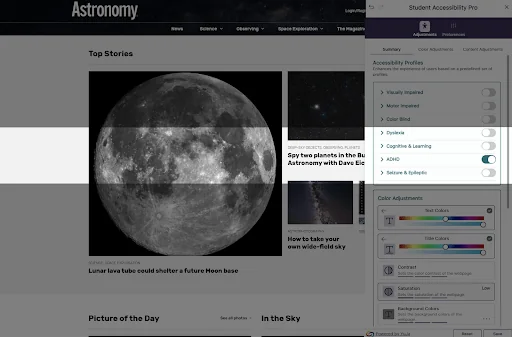
    A computer screen with a section of the page highlighted. In a classroom setting, students with ADHD may experience difficulty concentrating, managing time, staying  organized, or filtering out distractions. While these challenges can affect academic performance, they also underscore the importance of inclusive educational practices that cater to diverse learning needs.  Students with ADHD may benefit from external support structures, such as accessible technology, visual aids, interactive content, and learning materials that can be consumed at their own pace to help them stay organized and manage their workload.

    Supporting Students with ADHD in the Classroom

    Creating an inclusive learning environment is crucial for students with ADHD. By offering flexibility and accessibility, educators can help alleviate some difficulties students face throughout their learning journey. Support students by:
    • Offering Multiple Formats for Different Learning Styles: Students with ADHD often benefit from engaging with content in various ways. Providing materials in different formats—such as audio, simplified HTML, or accessible PDFs—can give students the choice to engage with content in the way that suits them best. Some students may prefer listening to a lecture while others might find a more structured, visually simplified version of the material helpful.
    • Reducing Cognitive Overload: Students with ADHD can experience cognitive overload when presented with large amounts of information. Offering students materials in digestible formats, such as breaking down complex readings into simpler language or organizing content in a clearer, more structured way, helps ease this burden. This approach can help students stay focused and absorb what they are learning without feeling overwhelmed.
    • Encouraging Independence and Confidence: Encouraging students with ADHD to take control of their learning process can boost their confidence and autonomy. Offering them access to content in multiple formats gives them the tools to manage their own learning without relying solely on accommodations, helping foster a sense of ownership over their academic journey.
    • Supporting Time Management and Focus: Time management and focus can be significant challenges for students with ADHD. By making learning materials more accessible and easier to navigate, educators can reduce the time spent searching for content or struggling with formats. This allows students to dedicate more energy to understanding the material and staying on track with their studies.
    By recognizing and supporting the unique ways in which students learn, educators can create a more equitable and effective learning environment, whether it’s through accessible content, personalized learning experiences, or a greater awareness of neurodiversity.

    Fostering an Inclusive Educational Landscape

    Here are some other ways to get involved this month: 
    1. Learn and share: Attend workshops or webinars. Spread accurate ADHD information on social media. Share your personal experiences.
    2. Plan an ADHD walk or community event: Get your chapter or community members involved in a day of walking to spread the word on how to move forward with ADHD. 
    3. Build Community: Join or start an ADHD support group and connect with others interested in supporting those with ADHD.
    4. Advocate: Support policy improvements for ADHD accommodations in schools, workplaces, and healthcare. To get started, write to decision-makers or join advocacy groups.
    “ADHD is a serious public health issue,” says Roxanne Fouché, director of the ADHD Awareness Month Coalition and the chair of ACO’s Global ADHD Resource Team. “But it doesn’t have to limit anyone’s goals in life. We are working toward a world that empowers all people with ADHD. A world where every person with ADHD is encouraged to use their strengths. Where all are free to ask for support and to seek appropriate treatment.” Creating an optimal learning environment for students with ADHD extends beyond providing accommodations. It’s about creating a flexible, supportive environment where every learner can excel. Learn more:  https://chadd.org/awareness-month/ https://www.adhdawarenessmonth.org/
  • September 23, 2024

    Tips for Implementing Secure and Scalable Exam Proctoring

    Recent research shows that both automated and live remote proctoring produce comparable results to traditional test-center proctoring, that test-takers find remote proctoring easy to use, and that students are supportive of proctoring platforms being more widely adopted. Here are five steps to implement effective and scalable proctoring: Use Multimodal Proctoring Tools: To build a scalable proctoring solution, institutions should adopt a versatile proctoring solution that offers both automated and live options. This flexibility allows institutions to scale their approach based on assessment complexity and integrity requirements. Automated proctoring uses AI for monitoring, while live proctoring provides human oversight for high-stakes exams. Implement a Cloud-Based Solution: Whether institutions are looking to expand their online offerings or provide students with testing flexibility, leaders should consider a cloud-based proctoring solution to support their goals. Cloud-based platforms allow institutions to scale their proctoring services without infrastructure investments, accommodating larger numbers of proctored exams as needed.
    A custom-tailored approach allows institutions to allocate resources efficiently, without overburdening departments that don’t need comprehensive proctoring.
    Customize Proctoring for Specific Course or Department Needs: Scalability requires flexibility, especially in large institutions with various departments. To address this, institutions should implement flexible proctoring solutions that can be tailored to specific departments or courses.  Tools like YuJa Verity’s LMS Hierarchy Support enable administrators to add proctoring to specific sub-accounts, departments, or campuses as needed. For example, while a physics department may require automated proctoring for midterms, a law department could benefit from live proctoring for final exams. A custom-tailored approach allows institutions to allocate resources efficiently, without overburdening departments that don’t need comprehensive proctoring. Ensure Security With Advanced Features: Prioritize security in online proctoring by using tools that offer comprehensive system checks, require full-screen sharing, and track browsing activity during exams. These features ensure compliance with academic policies and maintain the integrity of assessments. Provide Comprehensive Training and Support: A successful proctoring strategy hinges on educating both instructors and students. Clear guidelines, training sessions, and support for faculty using the platform are essential. Look for proctoring tools with user-friendly interfaces that simplify the process for all users and consider providing practice assessments to familiarize students with the system before their exams.

Join the 1,000+ Organizations Deploying High-Impact Solutions
A collection of logos representing various organizations and institutions that use YuJa’s platform.